Real people. Real results. Discover how cognitive restructuring has changed lives.
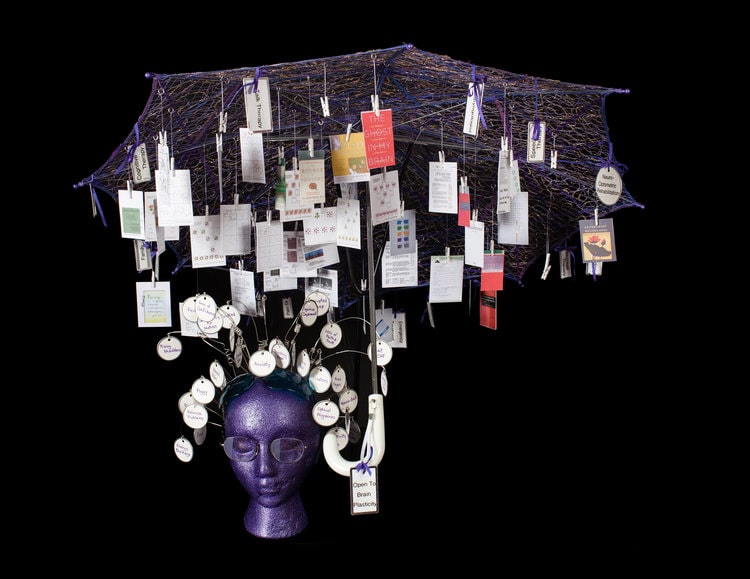 "Open to Brain Plasticity"
Brain Plasticity refers to the ability of the brain to change itself, to rewire.
This work is an expression of my gratitude for the professionals of the many healing paths I have taken to get my "Self" back, post injury and concussion. The umbrella, made of constructed cloth, is a loose representation of the synapses made by our magnificent brains. From the head spring many of the symptoms which occur simultaneously. Think of the inside of a telephone cable, with multiple colored wires, bare in spot and shorting out as they touch.
Each of the eight sections of the umbrella is devoted to a phase of healing with dangling visual representations of some of the healing steps, a process that is ongoing.
This is a very brief summary of a long and difficult internal invisible injury and journey. Integrating Traditional Medicine and Alternative Therapies, I build a dancelike interweaving of complimentary approaches, each working toward the common goal of brain plasticity.
Dr. Deborah Zelinsky O.D. referred me to Cognitive Therapist Donalee Markus Ph. D. who said that her exercises would result in the return of the "pictures in my head." It is a frightful loss for an artist to the pictures. Mine had gone, along with my creativity, in the moment of the crash nearly three years ago. Cognitive exercises brought the pictures back.
Janette Gerber
Textile Artist / Designer
Following a serious accident and a resultant TBI, I needed many types of therapy- physical, visual, and cognitive- and completed multiple programs. Although I had massive improvement in my day to day functioning, I still didn't "feel like me." My cognitive functioning did not allow for the level of intellectual life that I have always enjoyed. Reading was still laborious, I cognitively tired quickly, I still had trouble expressing complex thoughts, and I couldn't drive due to being unable to process visual input quickly enough or for a sustained amount of time. I completed the program with Dr. Markus and I got my life back! I have re-engaged with the world and now I'm not only driving, but doing research for a community project in education, tutoring children, and reading literature for pleasure. In other words, I'm "me" again. I can't thank Dr. Markus and her staff enough for their help and support. I have recommended her computer games and paper exercises to my tutoring students and my grandchildren are doing them, as well. Brain training is the missed opportunity in our educational system and I am doing my best to evangelize for its implementation. I have also recommended Dr. Markus' program to my friends.
L. T.
Client
I was referred to Donalee Markus after suffering (a second) traumatic brain injury caused by a car accident. I experienced all the usual symptoms of TBI and my brain just hurt. I found I was not able to remember things the way I could before the accident. The first thing Donalee did was give me a pair of dark glasses and told me to wear them all the time. Literally, ALL THE TIME, day and night. She said this would help calm my brain by blocking the constant overwhelming visual input to my brain through the retina. She was right! My brain started to calm and life became a bit more bearable. The mounds of paper and pen games she has designed start out basic and become more complex as you progress through the program. There is a lot of repetition but there is a system; a consistency that creates order which eventually reconfigures your brain and allows you to think differently. The games are definitely challenging but also fun. Donalee is one sharp lady. She is not only very gifted in the area of cognitive restructuring, but a wonderful, caring person as well. She really pays attention to how you are doing the games, focusing on the process. I recommend her to anyone who has experienced the debilitating symptoms of TBI and is looking to improve their memory and brain function. Donalee, thank you for helping me feel like me again. I will forever be grateful for the amazing work you do and how you made me feel.
J.M.S.
TBI Client
Around 2010-2011 my son, Peter, and I worked with you. Peter had learning issues and was flailing after barely graduating from high school. I was an emergency physician at Illinois Masonic. We were referred to you to help Peter and you invited me to participate. You put me through the NASA program and Peter followed along. I really enjoyed the program. He didn't complain about it.
For me, the success included calming down on my ER shifts, teaching the residents about the three different types of problems to solve - structured , semi- structured - and pointing out to them where they were and how to proceed. This made my shifts so much more satisfying. I became a leader in the medical staff and eventually department chair. I'm now retired from ER and have moved to Ann Arbor.
I am most excited about how Peter has succeeded. He graduated DePaul theater school in Acting. He did the bartender/acting thing for a while. He decided, with mentoring from his former teachers at the Chicago Academy for the Arts, to become a high school social studies teacher. He earned a Masters in Secondary Education at DePaul with a 4.0 grade average. During and after grad school, he worked four years at the Academy for the Arts. He is now a full time teacher at the Idyllwild Arts Academy in California. He loves teaching and is beloved by his students.
Thank you for your role in our success stories.
Julie V, MD
Emergency Physician and Parent
California resident Kiared (Kia) Pashminehazar realized he needed professional help for a series of prior concussions when suddenly he was forced to stop in his tracks while walking to a lecture as a sophomore on his college campus. "I was powerless to move my legs. I just stood there for about 30 minutes. I missed most of the lecture."
A second odd incident occurred while Kia was taking an exam in one of his courses. "I could not turn the page of the exam. It just sat there on the desk in front of me. I checked my watch. Seventeen minutes went by before I could continue the test," he relates.
"Not at all surprising," says Deborah Zelinsky OD, an internationally renowned optometrist and one of the professionals to whom Kia eventually turned for symptom relief. As founder and now executive research director of the Northbrook, Illinois-based Mind-Eye Institute, Dr. Zelinsky has spent much of her 30-plus-year career in developing — and applying -- advanced optometric methods to assess brain function, with emphasis on the often-untested linkage between eyes and ears.
Headaches; brain fog; double vision; difficulty reading, comprehending, and concentrating; loss of executive function abilities; problems conversing and managing time; spatial mapping deficits; and balance and posture issues are among the common symptoms of serious brain injury and concussion.
"When intact, visual processing enables people to understand and interact appropriately with the world around them. If brain circuitry is out of sync because it has been disrupted by neurological disorder or trauma, as was the case with Kia, people can become confused about their surrounding environment and exhibit inappropriate reactions and responses. When eyes and ears are not integrated, people have to continuously shift attention, and that effort becomes exhausting," says Dr. Zelinsky.
She is the first scientist to analyze how synchronization of the senses, especially eyes and ears, affects a person's ability to process the environment.
Eye-ear integration is the concept underlying the clinical work and experience at the Mind-Eye Institute. The team there uses therapeutic lenses, filters, and other optometric interventions to change the way light passes through the retina (which is made of brain tissue and part of the central nervous system), thereby affecting how the brain reacts to information about the environment and restore auditory space.
"Our sensory systems are like musicians in an orchestra. Each musician may be highly skilled in a specific instrument, but without a conductor synchronizing what they are playing, the result is simply noise — not music," Dr. Zelinsky says.
"I sustained my first concussion — what I considered a run- of-the-mill injury -- playing flag football during my freshman year at college," Kia recalls. He says symptoms were relatively minor at first, but the situation changed dramatically when he experienced two more concussions in the ensuing five months.
"As I was entering my sophomore year in the fall of 2017 — after my third concussion, my symptoms significantly worsened. I no longer seemed in control of my brain and body," says Kia. "I was unable to sleep properly and would not awake refreshed and recharged. I had extreme fatigue, making it difficult for me to get through my day. I had barely enough energy to get through my classes. I was in constant pain from headaches, and, cognitively, I was a mess. I would lose my train of thought. It would disappear, evaporate, and I would no longer know what I was talking about. I had difficulties reading and maintaining focus. Looking at text on computer screens was impossible."
He was studying computer science at the time and had a natural ability for mathematics. "But those [math-related] brain pathways dissolved after my third concussion. When I looked at an equation, all I could see now were characters on a page or on a [lecture] board. They seemed to have no connection to each other."
The symptoms forced Kia to take winter quarter off from college. "I had been lying to myself that things would get better; instead, they only became worse," he says. Kia sought help through the standard health care system, including a sports concussion clinic, "but no one could diagnose my problem or tell me what I should do [to heal]. Kia returned to college in the spring of 2018 "with limited energy. I took only two classes and was struggling through those. I did not want to live like this. I could do less than one-tenth of what I had been able to achieve before my injuries." He had been looking for books about concussion on Amazon.com when a book title - The Ghost in My Brain — caught his eye. He ordered it.
"Within the first 50 pages, I realized the author knew what he was talking about," Kia recalls. "Before I finished the book, I scheduled appointments with Dr. Markus and Dr. Zelinsky. That book gave me hope."
In the book, Chicago DePaul University professor Clark Elliott PhD details his eight-year journey back to health following a traumatic brain injury in a car crash and credits Dr. Zelinsky and cognitive restructuring specialist Donalee Markus PhD., founder and president of Designs for Strong Minds® in Highland Park, Illinois, for his recovery. Designs for Strong Minds® offers graphics that are intended to address a patient's spatial perception, visual closure, part-whole relationships, variation in perspective, form constancy, figure ground, visual imagery, and memory skills — all of which can be compromised by head injury, Dr. Markus states.
"There are many different levels of cognitive exercise to build, rebuild, or enhance learning. To habituate new patterns of behavior requires patients to complete numerous complex puzzles," Dr. Markus says. "One aspect of visualization is being able to create pictures in your head. When we say a word, we have the ability to create a mental picture. Some individuals can conjure very complex imagery; others are able to use their minds to rotate shapes in time and space. Some can see the big pictures, others only the details. Our goal is to get patients both to see the big picture and to integrate the details in many different ways."
Kia spent about four weeks working on Dr. Markus' puzzles and underwent testing and evaluation at the Mind- Eye Institute. Dr. Zelinsky prescribed him a pair of "brain" glasses, and Kia opted to take a year off from school to focus on recovery. Initially, Kia expected the glasses would miraculously heal his brain in a matter of weeks, "but I realized that improvement has to go forward step-by-step and requires sacrifice, patience, and motivation. You have to be as much a participant as a patient in the process. I have been returning to the Mind-Eye Institute every three to six months, carefully recording everything I have been experiencing. Each new pair of prescription eyeglasses has unlocked so much more of my capabilities."
Kia believes that, as of today (January 2023), he is more than 80 percent back on the road to where he wants to be. "I am able to converse again, exercise again. My reading, math skills, and time-management skills have returned. I no longer feel limited. In fact, in the middle of all these health challenges, I was able to graduate college in 2022 and earn my degree.
"Dr. Zelinsky and Dr. Markus have given me joy again. I am confident now that I am continuing to improve and know that, at only 24 years of age, I have the whole world in front of me."
Although Kiarod Pashminehazar is enjoying progressive symptom relief, his experience is not always the norm nor is it guaranteed for every patient. Check out the Mind-Eye Institute website at www.mindeye.com for additional information.
Kiarod "Kia" Pashminehazar
College Student
I am an financial analyst and this was a long journey until I found a cure for my concussion. My life played out like a movie-- The kind of movie that once it is finished you thank god it was just a movie and you are safe and sound on your couch. I saw many doctors and most of them just didn't understand my symptoms. My family thought my symptoms were psychological and I needed therapy. So I did it for years. Of course, doing therapy never tackled my real issues. But after seeing Donalee my life started to change in the blink of an eye. One week after seeing Donalee and the other professionals she recommended, I flew back home And my mom said: "You are so much better, you are more like the son I know, you don't need psychotherapy, you just need to keep doing this treatment!" Of course I was better, I was more present, attentive, more balanced. I used to drift to the left when walking and had to consciously correct my self. Well, that went away. It's been 5 weeks since I first saw Donalee. I am not 100% back to what I used to be but I am getting there, and fast!
R. F.
Financial Analyst
I am a computer scientist who deals with very abstract concepts every day in my work. My job is to connect those abstract thoughts to reality. I suffer from traumatic brain injury (TBI) and found Dr. Markus and her exercises to be one of the only things that was able to help me. When you have TBI there are some brain states that your brain gets stuck in. This makes it hard to think the way you should normally. In particular I had lots of trouble when changing from one type of thought to another. This would cripple my ability to do almost anything. That sounds a bit dramatic, but it's really true - and it was tragic. I had to stop working as a result.
Dr. Markus' puzzles are just a bunch of paper puzzles. You do them with a pencil and eraser. What she watches is how you reason through the puzzles. As a result of working these puzzles, I found that my reasoning ability changed. After doing the puzzles for about six months I was able to return to work part time, and to work better. At my worst I couldn't work at all. A year and a half later I'm working almost full time, and well. Dr. Markus' exercises have helped restore my life - and to put me on a path back to being the person I was before my accident.
C. H.
Computer Scientist
I was on the job for SBC one Saturday morning four years ago, parked in my truck, when I was hit head-on by a reckless driver. I recovered quickly from a concussion, but was subsequently plagued with post-concussion syndrome: I was hypersensitive to noise, my field of vision was broken down to pixels rather than a whole integrated picture – in fact, all my systems were hyperactive.
Doctors wrongly told me I'd be good as new in a year; what did make all the difference was working with Donalee, who said, "Life's going to be different from now on, so let's make good use of it." It took me less than four years to retrain my brain with Donalee Markus, and I'm back with SBC, splicing cable – thanks to Donalee, I'm able to lead a normal life.
Don K.
Father of Eight
A catastrophic car accident at age 16 left my daughter Krysty with a traumatic frontal-lobe brain injury and a broken neck. Her physical wounds healed, but her brain did not – until we took her to Donalee Markus. Krysty arrived at Donalee's office with her higher functions, including executive function and critical thinking, gone – along with 20 points from her IQ. She was almost emotionless and operating at an 11 year old's social level.
Donalee taught us that our minds work with, adapt to, and change the brain. We worked with Donalee for four hours a day/three days a week. As my daughter's mind pushed her brain, she developed new, healthier neural pathways. In working with Donalee, we learned that executive function and critical thinking are teachable, and, since the right instruction guides the mind and consequently the brain, cognitive restructuring can correct brain deficiencies; you just have to know how to do it, and that's exactly what Donalee does.
Krysty left Donalee's office with new neural pathways and a whole new approach to thinking and learning. Now, 16 years later, she is a 32 year old licensed massage therapist with a wide practice; thanks to Donalee, Krysty can learn any new modality she wants and respond to every client's needs.
Kathy A.
Parent
In October 2006, I was interviewing a new client of the publicist who employed me as a writer of press materials, when I suddenly experienced what felt like a sledgehammer blow to the back of my head. I lost consciousness, and upon awakening – on the floor – found I was hallucinating. Day-glo colored cartoon characters were dancing and talking to me in the interior of my mind. Then, as I tried to make sense of where I was – and what was happening to me – my language skills disappeared, and my visual field broke up into a jigsaw puzzle. Lacking the linguistic or figural capacity to identify any of the shapes or colors I perceived, I could not identify the physical or human details in the room in which I'd fallen.
Arriving at an emergency room about 30 minutes after the bleed occurred (my last accurate long-term memory), I underwent CAT scan and MRI and was packed off to a hospital bed for observation. I was released from the hospital after about three days and a diagnosis of a "small bleed" in the right occipital lobe. The hemorrhage site was deep within that lobe in an area typically reserved for higher order visual processing. The neurologist didn't expect this to have a very significant impact on me, but he was wrong.
Briefly put, I lost my ability to read, write, do math, maintain a conversation, recognize myself in a mirror or in photographs, perceive depth, move smoothly in any direction (I could no longer drive), tell time, remember sequences (including multi-step instructions), or follow the plot of a movie or television show. My mental images disappeared – I could no longer "remember" the faces of family members or what my living room looked like, and when I tried to imagine something in my mind's eye, nothing showed up. My visual skills regressed to those of a preschooler, which effectively ended my career.
As time progressed, I slowly returned to a level at which I could function independently (i.e., I could shop for groceries; I could drive, although I had problems with speed and distance; I could tell time; I could read a recipe in steps; and I could read text more easily, although comprehension was sorely compromised). Doctors told me I had recovered well and was doing great; they believed I'd reached a plateau – had gone as far as I could go with healing – and should be happy with my regained functionality.
By 2011, I was so frustrated by the medical profession's assessment of my healing that I contacted Dr. Zelinsky, whom I'd heard speaking on a radio show about eye-brain connections and brain trauma. Dr. Zelinsky referred me to Dr. Markus for cognitive restructuring work.
I worked with Dr. Markus for several years (2011-2014), and with her paper-and-pencil puzzles – as well as some iPad puzzles – recovered a great deal more functionality than I'd regained in my first five years of recovery. These puzzles are designed to restructure the visual pathways in the brain; they entail such activities as sequencing, analysis and synthesis, critical thinking, memory building, problem solving, and sustained attention. The mental images began to return; I improved my visual memory; I could now follow a plot; I could read and understand a short story (which had been impossible); my ability to have a conversation and to understand body language and other visual cues improved dramatically; I could do basic math in my head (whereas I couldn't even see the numbers when I first went to see Dr. Markus); and I could finally drive and perceive depth well enough to safely navigate parking spots and garages.
Do I still have deficits? Yes, many of them. But do I function at a much higher level? Absolutely! Thanks to the brilliant, dedicated, individualized work of Donalee Markus, I have regained and learned a number of important cognitive skills. Dr. Markus possesses a unique ability to assess cognitive needs and to prescribe effective exercises that truly build new neural pathways in the brain. And she and her staff work patiently and one-on-one with clients, ensuring that individuals are progressing – or changing direction when indicated.
The work is never easy. The puzzles are challenging and very difficult. But I cannot adequately express the great appreciation I have for the huge leaps I made in cognitive ability as a result of the work I did with this inspiring woman. And I strongly recommend that anyone suffering from TBI, stroke, concussion, or learning challenges give this approach a try. The results can be – and were for me – life-changing.
At the age of 83, I came upon the Strong Mind Puzzles App. This app is so much fun that I can't wait to get up in the morning to work on the computer in the privacy of my own home. It's fun and fast paced with 10 levels. I recommend it to my friends of all ages - young and old - because it's easy to use and FUN!
Julie S. - Retired Psychotherapist
I want Dr. Markus to know that the puzzles were some of the most helpful things I have ever done for my brain. Not only did I fully recover from my Dec 2020 concussion, but with the help of the puzzles and Dr. Z's glasses I went well past my initial baseline. I ended up excelling so much cognitively, that I was able to take a position in New York running an entire trading desk on Wall Street. I have performed very well and have had a fantastic start to my career there. I'm very excited about my future. Also wanted to share with you both that I just returned from a trip to Copenhagen and had zero issues traveling via plane, something that would have been impossible with post-concussion syndrome. Not a hint of light or sound sensitivity.
Dr. Z deserves so much credit for not only the brain glasses but her attention to my eyes and the brain-eye connection. I also need to thank you both for introducing me to Dr. Ryan Oughtred. Dr. Oughtred's help in calming my brain through the use of neurofeedback was integral to my recovery. I could do puzzles and interact with the outside world better after each neurofeedback session. You guys have given me my life back, and I don't know how I could ever thank you enough for that.
D.M.
Client
 Dear Donalee & Margit,
There is a beautiful Japanese phrase "otsukaresama" which is used to express gratitude. I love this word because it directly translates to "you are tired", acknowledging the effort that kindness and good deeds take.
Otsukaresama to you and Margit. Thank you for your care, hard work and compassion. You have given me back my sense of self, my confidence, my emotional stability and my hope. You have shown me the value of patience, the value of a positive attitude in the face of hardship and the value of dedication to a cause. Your belief in me and in the effectiveness of your approach has been unwavering, even when mine waivered. Your friendship and support will not be forgotten, nor will your kind words.
I am proud and grateful to be a small part of the important work that you do. I hope I can be of service to any future clients who struggle with symptoms similar to mine. Margit, thank you for always making me laugh and reminding me to enjoy the small things along the way. Thank you for sharing your personal experiences and for your honesty. Donalee, thank you for always knowing what to say. Thank you for helping me learn to trust myself again. Thank you for pushing me to accept every challenge and overcome every obstacle.
Wishing you all the best. Until next time, Brooke
Brooke
College Student
Great for speech therapy as well
I am a speech therapist, and I downloaded this app and the Rocket 123s. I have been using them for an adult patient with a reading impairment (alexia) and a vision impairment (field cut). It has been fantastic. The format is simple enough that she can understand what she's supposed to do and the graphics are well done but not too immature for adults. She really enjoys it. If I were working with a child learning his/her letters, I would definitely recommend it as well since teaches them to identify the letters in a variety of contexts/orientations.
M. R.
Speech Therapist
Before I started working with Dr. Markus I really didn't believe I was stupid, but I believed I was a failure in many areas. I would sit in the classroom and listen to other students talk about what they liked about a book they had just read. I never knew what to say. I could read the book, but I couldn't visualize the scenes to know how I felt about them. After a year of working with Dr. Markus I sat in English class and was not only able to answer questions with the rest of my class, but my answer was chosen as one of the best. Before I worked with Dr. Markus I not only couldn't answer questions but I couldn't even ask questions. I also realized that I couldn't think about my thinking. Now I can think about my thinking and I can tell if the conclusions I come up with are good. I am better today than I was before and still getting better. When I came in for my interview at Loyola University, I answered her questions for over half an hour. I talked about how I think in my classes and she said, "That's so self aware!" I would have never been able to do that before working with Dr. Markus.
Aleksa
Student
Dr. Markus opened my mind -- helped me see the big picture. I was locked in my own little mind and I did not even realize it. My confidence has soared. I am now actually popular at school and no longer struggle with academics.
Rachel
Student
Before getting help from Dr. Markus, I struggled in a lot of areas in school. I got bad grades, I couldn't focus and I just hated being at school. After spending time over the spring and summer working with her, everyone could see a change in the way I thought and the way I did things. She helped me think about my thinking and I became more confident about my problem solving abilities. This carried over into my performance in school. First semester, as a sophomore, I was on the B-Honor roll for the first time. I felt great about myself. My problem solving skills also help me on the football field. When I find myself having a bad game and I am frustrated, I think through my problems and work to solve them until I am confident that I can beat my opponent. Now I am getting letters from Division 1 schools asking me to visit them. Dr. Markus believes in me and I have learned to believe in myself. Thank you Dr. Markus!
Patrick
16 year old Student Athlete
We were very blessed that our son's physician referred him to Dr. Markus. I remember back to that first visit. We were walking down the hall and my son was skipping, my son does not skip!!! What was that about? I said it is all the energy he has pent up because he is never successful. To this day I will never forget what Dr. Markus said... she said to my son "You do exactly what I tell you and I WILL get you THERE!" I thought that was such an odd thing to say. After visiting Dr. Markus for four weeks my son started to read. I was listening to him read and I cried. He always did reading in his head so I never heard him read out loud. I heard him read with intonation and read as if he understood what he was reading. I could not believe what I was hearing. I could tell he had a hunger to read more. As parents, we were amazed by how quickly he got better. He is now on the High Honor Roll at school. I am telling you this because it is so important that all children get this kind of help. If you suspect your child has learning issues please get them tested and seek the help of Dr. Markus. I know there are a lot of kids out there right now that would benefit from DSM if only they knew about it.
Patsy T.
Parent
My older daughter, Mara, who has the visual processing disorder that some call dyslexia, had no idea how intelligent she was until she started working with Donalee: as early as fifth grade, she was staying up till midnight every night, just trying to keep up with her homework. But when Mara started going to Donalee when she was almost 16 years old, it was like her brain just started switching on. For the first time, I could see her beginning to make connections and see patterns. Mara's writing reflected her new thought processes as she began to write clearly and fluently and with correct grammar. Not having to struggle for every word and every sentence, Mara is now free to be creative and thoughtful with her writing. And she's now doing math at her actual level (at the top of her class in AP Statistics and Calculus 2).
Donalee's restructuring makes such a huge difference for kids (or adults) whose brains just don't work in a standard way. It's like she's building new, better roads through the brain. Of course, I also made Mara's younger sister, Clara, start working with Donalee at the beginning of middle school (even though Clara had strong grades and didn't struggle), and it's paid off tremendously. Clara's at the top of the class now and has just won a handful of major national writing awards. Beyond the school and outside rewards, what matters most is that both my girls now feel confident in their own abilities and pleased with themselves. They know they can do the work, and they enjoy what they're learning. Thanks to Donalee!
Gail G.
Parent
The experience we have had with Donalee and her program could not have been better. My daughter started to work with Donalee when she was 15 years old. She had been in learning support since kindergarten and we knew that we needed to try something different as she was approaching high school. She improved immediately. She used to get 40's on her tests and now she gets 80's and 90's. Donalee didn't just help her do better on tests. She taught my daughter how to learn. She knows how to organize information. In her senior year when asked by one of her teachers "What changed you?" she said "Dr. Markus taught me how to learn."
Martina
Parent
The program that Dr. Markus has established for her students is one that holds tremendous value to all those who she helps. I first started doing her exercises when I was in third grade, and it is from years of working with her that I can say I am one of her many success stories. My severe learning disabilities began to affect me more and more in my studies as I advanced through school, until I was introduced to Dr. Markus and her exercises. After I began working with her my grades began increasing to the point where I was inducted into the National Honor Society and now I have been accepted into the Honors Program at the University of Iowa. The accomplishments of my high school career would not have been nearly as impressive without the work I did with Dr. Markus. My hope is that anyone looking for the opportunity to be successful in academics will discover Dr. Markus and her exercises because they, just like I, can become success stories.
Ari
Student
I thank God every day because one of my son's therapist told me to google Dr. Zelinsky, and her website mentioned Dr. Markus' name. I will always remember the first meeting with Dr. Markus. She told me I was going to see changes. She told me it wasn't going to be easy. And she told me my son needed to come to her twice a week. I took my son to many different doctors and therapists, and I was getting nowhere and I needed help, so I followed her instructions without a doubt.
Dr. Markus and Dr. Zelinsky were very clear. They told me they were a team. They both needed to work on my son in order for him to make any gains. But the changes my son made were possible, not only because Dr. Markus and Dr. Zelinsky are two great, committed professionals; it was also because my son gave his 100% at every single therapy session. I saw him come back home tired, but ready and willing to go for his next appointment.
When my son first started therapy with Dr. Markus, his brain was disconnected, his body was disconnected. His body was there, but he was not present. He was never mad or upset, but he was never happy either. He was in his own world and he seemed quite content there. Making friends was very hard for him. He just didn't have the tools. He also had motor planning issues and an extremely poor core and balance. As a result, it was like his body worked against him. He was very slow. He'd get frustrated and have ugly tantrums. His mornings getting ready for school were horrible. For him, getting to school on time would stress him out. As soon as he woke up, it was like his body was in the way and his mind was lost. He knew he was supposed to wake up, wash, get dressed, eat breakfast, put on his shoes, jacket, check his back pack and go to school. But in the middle of all those tasks, his mind would go elsewhere. Many times he would end up in his room playing with his favorite toys and forgetting about getting ready for school. Every morning I had to redirect him in order for him to get ready and make it to school on time, and being late was not an option for him.
I saw my son struggle at home, with his clothes, with his shoes, with eating, sleeping, waking up, getting ready for school on time, and then I saw him struggle at school with academics. His report cards were heart breaking. His teachers were great, but most didn't have any magic to offer. It was his first grade teacher that wanted me to take action. She told me my son needed help and that I shouldn't wait any longer. That's how it all started. I immediately took my son to Children's Memorial Hospital to have him tested. Six months later, I finally got the results. They told me my son had an extremely low processing speed. He was also visually impaired (they said his brain wasn't processing what his eyes saw) and he had Sensory Processing Disorder. They prescribed O.T. I didn't know anything about the therapies suggested, but I wanted to help my son. My son started O.T., even though it was very expensive and Insurance would not cover it. Month after month went by without any improvement. My son continued to struggle and after a year of therapy we had to stop it because we simply couldn't afford it anymore. (Three years after that, I wish we never took him to Children's for the initial evaluation. Everything suggested was a waste of time and money. We accomplished nothing after several appointments and therapy that we paid for).
After 3 months of intense hard work with Dr. Markus, she told me my son was doing much better. I couldn't understand however why he was still getting frustrated when doing his Math homework. Dr. Markus then told me that he needed to go back and learn all the Math basics that he missed in the past.
That was it. She found the piece missing. His mind was ready to learn and she knew it.
Dr. Markus and Dr. Zelinsky were always in communication about my son. They were always on the same page.
Around that same time, Dr. Zelinsky found great improvement in my son's eye sight system._ His eyes were now working together. She gave him his 3rd pair of lenses and it was little after that when many things started to change. I felt as if everything was finally falling into place.
When we met with his teacher during the teacher conferences a month or two after that, she told my son she couldn't believe the leap he took in Math. She said that what his Map Math test showed was not normal. She said she didn't know what he did to make that change happen, and asked him to continue doing whatever it was.
My son is now 9 years old. His balance and his coordination have improved greatly and he is running much faster. His core and fine motor skills are improving day by day, as well as his handwriting. His motor planning is much better and he is getting stronger. He doesn't knock down his cup nor he bumps into furniture any more. His mornings are so different now. He looks at his watch, knows how many more minutes he still has to do whatever he still needs to do, frequently walks to school on his own and gets there on time. He is less fearful now. He has started making new friends and is a happy kid in the playground. Also, his behavior has improved greatly at home. No more ugly tantrums. If he gets frustrated about something, his reactions are age appropriate now. He takes Math lessons after school and has learned to do his homework on his own. He brings home excellent notes and I haven't even taken a look to his Math workbook during the last trimester!
He still has some ways to go, but his mind and body are now in a much better place and he is catching up at a fast rate. He may not notice the difference, but he is now becoming more confident with his new mind and body.
I cannot thank Dr. Zelinsky and Dr. Markus enough for their hard work and passion to help. My son has made major progress physically, socially, emotionally and academically in a short period of time. Brain Plasticity works and my son is an example of that.
Maria L.
Parent
I don't know where to begin to find the words of gratitude, appreciation and awe.
We went out to dinner last night as a family. I was sitting across from Jordyn and had the perfect seat to observe her. It was my observation that she just looked happier. I don't know how else to say it. Her eyes were brighter and she was smiling more. When you have a child that has had as much treatment intervention as she has, you become cautious and almost afraid to hope. So I remained neutral in my comments.
Then I received a phone call from her regular school teacher who would not let me off the phone until I told her what we were doing with Jordyn. I must have sounded like a QVC sales person "but wait there's more."
Then I remembered that I had a long conversation with her case manager from Easter Seals. She could not believe the changes in Jordyn. She wanted to know what we were doing. Was it diet? What kind of medication did we put her on etc. etc... Again I felt like a saleswoman.
To make a long story short I received a long email from a family friend who spent some time with Jordyn and she listed all the positive changes she observed.
So when I compare these three independent observations that are all the same, there is clearly something going on! And I do feel it is extraordinary.
I say this all the time to Jordyn and I will say it to both of you. I strongly believe in my heart that we were guided to you. You are the missing piece in the care that Jordyn was needing. And we were all meant to be on this journey together.
Jordyn is a lucky girl to have this opportunity to shine. And I am one lucky mom to be able to watch it all happen!
Emily J.
Mother of Jordyn
My personal experience with Dr. Markus' work is that it lays a foundation for enabling personal mastery and enhances one's ability to understand his/her own thinking process. I introduced her exercises to NASA and our NASA employees felt that these exercises allowed them to see, understand and move beyond their own limits to thinking and awareness. Specifically, Dr. Markus' exercises open an individual's ability to explore and learn in a non-threatening and creative way.
Maureen D.
NASA
I have to be honest, when you gave your proposal although I love the exercises, I was highly skeptical of DSM being able to change my thinking and problem solving ability. I remember thinking, "How are a few exercises going to change my thinking or help me develop critical thinking skills?" Then after I went to the classes and continued to do the exercises I realized that I looked at problems differently and approached resolving them with a different attitude.
Jeff U.
Ameritech
Donalee - I wanted to follow up with you and let you know how blown away I am with the progress my Dad has made in just 5 days. Your work is amazing - you are so brilliant and I love to watch you observe and seamlessly integrate. You are a tough cookie and my Dad is loving every minute of it. He continues to impress me at 75 he is becoming stronger than ever. I am so blessed to have both of you as teachers!
Julie S.
Daughter of Client
For reference, you may remember when I was playing the paper version of Mind Mazes I wasn't satisfied because of how much of a logical conversation I had to have with myself. I had to very consciously think through what the options were for matching each time. I had to think very methodically about each shape in an order to see if I could connect with a line. I felt like I often got into a repetitive and non-constructive pattern. I'd continue to ask myself the same questions for two patterns, not quite remembering the other options I had already gone through, which ones I already determined matched, if it for sure wasn't a match. I generally would force myself to give up after a while, just look at another set of patterns for matches, but not really certain I'd ruled out the option of the two I'd been focused on.
Great news is that at least for this game I've broken that behavior. I played the app periodically while in Chicago on Saturday after our Friday appointment and got to level 50 before getting home Saturday night. I continued to play for 10-15 minutes a few times a day and had gotten to level 125 by by about the end of the week, so playing the app in total for about a week or less. I continue to play level 125 once a few times a day and am averaging about 1 minute or less to finish. It just feels right now.
It all seemed to "click" around levels 30-50 the Saturday after our appointment. At that point I started to better understand what I expected of myself, why I was frustrated by what I described above, even though you felt like I was doing fine, having a conversation with myself, going through logical steps, etc. When it "clicked" it's almost like my subconscious took over the processing. I didn't really need to go through a conscious logical process. I would just look at two shapes and "know'' if they shared two characteristics. If I stopped to think I could quickly describe (to myself in my head) what two characteristics matched.
Sometimes I'd get caught up with one or two of them and spend a minute fixated, but for the most part just move from pattern to pattern. Also great is that I can count on one hand the number of times I made a mistake caught during submission.
This is the first time doing your puzzles I've gone at the speed I expect of myself. Where I don't feel like I need to logically think through what process to follow to get the right answer. I don't know if I'm saying this right but it sounds like my subconscious almost just takes care of it. It's kind of crazy that my brain still expects this level of processing, that I get frustrated not having it, after 8 years of being level-set backwards after the accident. I guess that's just how the brain works though.
I'm currently living in Denver, Colorado, as a mixology instructor. A student asked about "my story" I told her how depressed I was and going to you changed my life and the impact you had on me and how happy I have been since. I felt like I had to share that with and give you an update on my status. I'm just enjoying life right now and am excited about this new adventure I'm on.
Thank you again.
Thomas Z.
Mixology Instructor