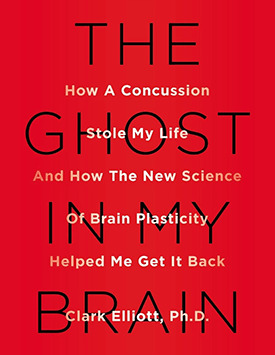
Dr. Donalee Markus' cognitive restructuring treatment is detailed in The Ghost in My Brain: How a Concussion Stole My Life and How the New Science of Brain Plasticity Helped Me Get It Back, by Clark Elliott, Ph.D., an unforgettable chronicle of recovery, one that provides a window into the tremendous power of the human brain and offers new hope to those suffering from concussion and other brain traumas.
Clark Elliott was a mystery to me when we first met. Observing him through my glass front door, I saw that it took him two minutes just to find the doorknob with his hand. When I gave him the simplest of my assessment tests—copying a geometric line drawing—his body went into bizarre contortions as he struggled to complete it. It hurt me to watch this brilliant man put so much effort into such a trivial task. In my decades-long practice in clinically applied neuroscience (CAN), this case was striking. During the two-hour evaluation session, I kept asking myself, “What could have happened in the car accident eight years ago that all of these top medical doctors have missed?” In thinking over my plan for rewiring his brain, I realized that most of Clark’s cognitive and motor behaviors were likely tied to stress on his visual systems, and I wanted him to work in parallel with my highly esteemed colleague the optometrist Deborah Zelinsky, whom he went to see the following week.
Clark was an ideal client. He understood the complexity of the brain and the relationship between sensory input and behavior. And he was compliant, faithfully completing the rigorous cognitive exercises that I created for him—the brain puzzles he was to solve on a daily basis. Most important, he carefully documented his behavioral changes so that I could move him quickly through the exercises that would allow him to regain control of his personal and professional life.
Clark’s story is remarkable. Through his scrupulously documented recovery, he gives a voice and provides hope to millions of people, referred to as the walking wounded, with mild to moderate traumatic brain injury. The plasticity of the human brain is both its power and its weakness. Although the life-sustaining parts of the human brain are “hardwired,” the cognitive parts (located in the neocortex) are not. The part of the brain that allows people to think, to plan, to hope, to dream, to understand language and math, and to recognize themselves and others, is highly malleable.
This plasticity allows people to change their minds and to control their behavior, but it is also this part that suffers the greatest loss from brain injury. Much to the frustration of doctors and patients alike, cellular damage is microscopic and may be diffuse throughout the brain so that conventional scanning technologies cannot detect it.
By the time high-functioning individuals with post-traumatic head injury notice that their memories are not what they used to be, or that they have difficulty thinking through a problem they could once have easily solved, massive brain damage has occurred on a microscopic level. Because their symptoms are medically unverifiable and therefore untreatable, they are usually dismissed as the walking wounded, destined to suffer the pain, frustration, and humiliation of not knowing how much longer their condition will last or how much worse it will become. The Designs for Strong Minds® system I have developed to treat such clients who come to me is a program based on a neurocognitive model that relies on the brain’s plastic, reconfigurable nature, and uses attention, intention, and rehearsal to implement learning and behavioral change.
It is important to give credit to two individuals who contributed to Clark’s cognitive restructuring success. Professor Reuven Feuerstein in 1981 introduced me to the original theoretical framework and the system that are the basis of my work, where the tools are context-free visual puzzles organized by logical structure, and the technique is mediation, to change the structure of the brain. It is from Professor Feuerstein that I learned “Intelligence is plastic. . . . Cognition is modifiable at any age.” And Christine Williams of NASA provided me with the opportunity to work with our top scientists, engineers, physicists—literally our rocket scientists—from 1998 to 2005. The tools, more than three thousand paper-and-pencil instruments that I created for NASA (joined by almost ten thousand instruments for children), became the framework, the structure, and the workbooks for Clark to regain his high-level cognitive functioning skills.
Warm regards,
Donalee Markus
The Brain Is Primarily A Visual-Spatial Processing Device: Altering Visual-Spatial Cognitive Processing Via Retinal Stimulation Can Treat Movement Disorders
Functional Neurology, Rehabilitation, and Ergonomics • Vol. 7, No. 3. 24.